 |
 |
|
 |
|
 |
|
|
|
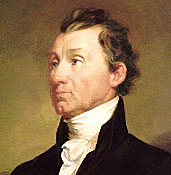
JAMES MONROE
1758 - 1831 |
|
|
Fifth President
United States of America 1817-1825 |
|
(1782-1783)
Member, Virginia House of Delegates and Governors Council (1783-1786) Delegate from Virginia to Confederation Congress (1787) Fredericksburg City Council (1787-1789)
Member, Virginia House of Delegates (1788) Member, Virginia State Convention to Ratify Federal Constitution (1790-1794) United States Senator From Virginia (1794-1796)
American Minister to France (1799-1802) Governor of Virginia, Three One Year Terms (1803-1807) U.S. Minister to England and Spain (1803) U.S. envoy to France to complete
negotiations for Louisiana Purchase (1810) Delegate from Spotsylvania County to Virginia House of Delegates (1811) Governor of Virginia (1811-1817) Secretary of State
(1814-1815) Secretary of War (1817-1825) President of the United States, two terms (1829) Chairman, Virginia Constitutional Convention |

|
 |
 |
|
|
James Monroe was born on April 28, 1758, in Westmoreland County in the area of Virginia called the "Northern Neck".
In 1774 he entered the College of William and Mary in Williamsburg. At the outbreak of the American Revolution he left the College and was commissioned a lieutenant in the Third Virginia
Regiment. He fought at the battles of Harlem Heights, Trenton, Brandywine and Monmouth, and wintered at Valley Forge with General Washington. The famous painting "Washington Crossing the
Delaware" depicts him as the young man standing behind Washington in the boat and holding the flag. By the end of the war he held the rank of Lieutenant Colonel. |
|
|
 |
|
|
After the war Monroe returned to Williamsburg to read law with Thomas Jefferson and to prepare for a life of public
service. He was very succesful in public service, being elected to more public offices than any other President of the United States. As is well known, his Presidential Message in December 1823
proclaimed what has been called his young nation's "Declaration of Independance in Diplomacy" known as the Monroe Doctrine. Monroe married Elizabeth Kortwright of New York City in 1786. The Monroes
had two daughters, Eliza and Maria Hester, as well as a son who died before the age of two. The Fifth President of the United States was never a wealthy man, since public offices in his time paid small
salaries and left him little time to earn money from law or from his farms such as "Highlands" (later called "Ash Lawn"). On July 4, 1831, James Monroe died at the New York residence of his younger
daughter. He was buried in New York City, but in 1858 he was reintered in Hollywood Cemetery near the James River in Richmond. |
|